
Specimen family
n = 15
Social Thinking Traps
Social thinking traps are cognitive biases deeply influenced by social dynamics and group behavior. These biases can lead to poor decisions, reinforce stereotypes, and contribute to the perpetuation of misconceptions. When individuals are part of a group, they might prioritize harmony and conformity over critical thinking, leading to decisions that can be flawed or even harmful. By understanding these social thinking traps, we can better navigate group interactions and make more informed, independent decisions.
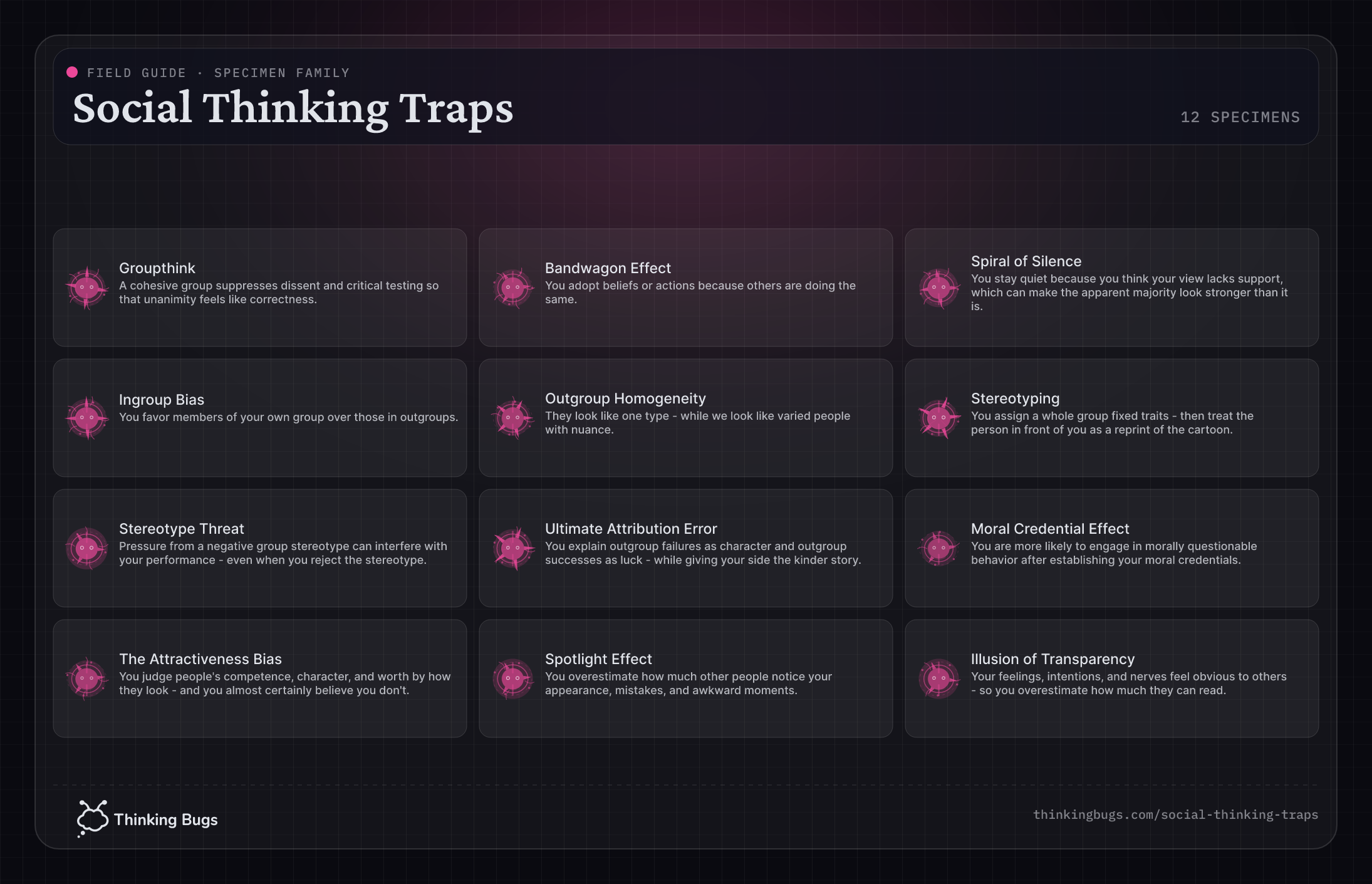

Groupthink
A cohesive group suppresses dissent and critical testing so that unanimity feels like correctness.
75 · Severe
GT
Bandwagon Effect
You adopt beliefs or actions because others are doing the same.
67 · High
BE
Spiral of Silence
You stay quiet because you think your view lacks support, which can make the apparent majority look stronger than it is.
72 · High
SoS
Ingroup Bias
You favor members of your own group over those in outgroups.
77 · Severe
IB
Outgroup Homogeneity
They look like one type - while we look like varied people with nuance.
70 · High
OH
Stereotyping
You assign a whole group fixed traits - then treat the person in front of you as a reprint of the cartoon.
77 · Severe
ST
Stereotype Threat
Pressure from a negative group stereotype can interfere with your performance - even when you reject the stereotype.
68 · High
STH
Ultimate Attribution Error
You explain outgroup failures as character and outgroup successes as luck - while giving your side the kinder story.
77 · Severe
UAE
Moral Credential Effect
You are more likely to engage in morally questionable behavior after establishing your moral credentials.
59 · Moderate
MCE
The Attractiveness Bias
You judge people's competence, character, and worth by how they look - and you almost certainly believe you don't.
69 · High
TAB
Spotlight Effect
You overestimate how much other people notice your appearance, mistakes, and awkward moments.
65 · Moderate
SpE
Illusion of Transparency
Your feelings, intentions, and nerves feel obvious to others - so you overestimate how much they can read.
65 · Moderate
IoT
Drama Triangle
Conflict locks into Persecutor, Rescuer, and Victim, and the heat comes from switching roles.
79 · Severe
DT
Yes, But
You ask for ideas, then defeat every one, so the talk ends with proof that nothing can be done.
73 · High
YB
If It Weren't For You
A real limit can also spare you from facing a choice that frightens you.
77 · Severe
IWY