
Specimen family
n = 13
CBT Thinking Errors
Cognitive Behavioral Therapy (CBT) is a scientific, well-tested, most proven, and most effective logical approach for challenging our distorted thoughts and transforming them from intrusive and unhelpful into rational and beneficial.
The irrational and often negative thoughts are common to different people. These thoughts are classified into different types, named together as cognitive distortions, also known as thinking errors or thinking bugs. By deconstructing and changing our irrational thoughts, we can greatly improve our life quality, performance, general well-being and solve many psychological issues, such as anxiety, panic attacks, depression, OCD, PTSD, ADHD, and similar.
The list of classical cognitive distortions is presented below. These thinking bugs can be spotted in our thought patterns and fixed using the Reframing App.
The irrational and often negative thoughts are common to different people. These thoughts are classified into different types, named together as cognitive distortions, also known as thinking errors or thinking bugs. By deconstructing and changing our irrational thoughts, we can greatly improve our life quality, performance, general well-being and solve many psychological issues, such as anxiety, panic attacks, depression, OCD, PTSD, ADHD, and similar.
The list of classical cognitive distortions is presented below. These thinking bugs can be spotted in our thought patterns and fixed using the Reframing App.
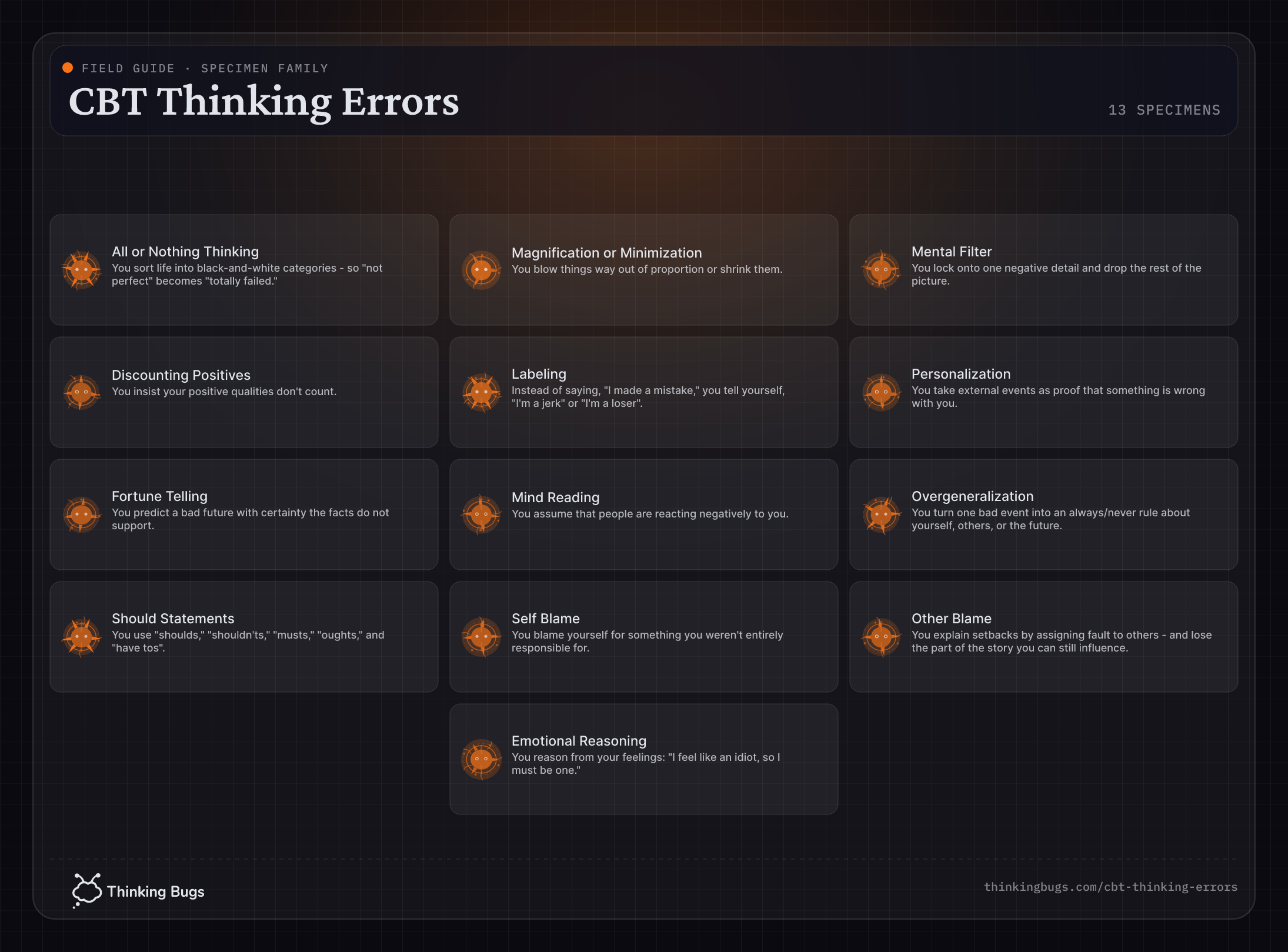

All or Nothing Thinking
You sort life into black-and-white categories - so "not perfect" becomes "totally failed."
70 · High
AoN
Magnification or Minimization
You blow things way out of proportion or shrink them.
63 · Moderate
MoM
Mental Filter
You lock onto one negative detail and drop the rest of the picture.
65 · Moderate
MF
Discounting Positives
You insist your positive qualities don't count.
62 · Moderate
DP
Labeling
Instead of saying, "I made a mistake," you tell yourself, "I'm a jerk" or "I'm a loser".
72 · High
Lab
Personalization
You take external events as proof that something is wrong with you.
63 · Moderate
Per
Fortune Telling
You predict a bad future with certainty the facts do not support.
63 · Moderate
FT
Mind Reading
You assume that people are reacting negatively to you.
70 · High
MR
Overgeneralization
You turn one bad event into an always/never rule about yourself, others, or the future.
68 · High
Ovg
Should Statements
You use "shoulds," "shouldn'ts," "musts," "oughts," and "have tos".
71 · High
SS
Self Blame
You blame yourself for something you weren't entirely responsible for.
66 · High
SB
Other Blame
You explain setbacks by assigning fault to others - and lose the part of the story you can still influence.
69 · High
OB
Emotional Reasoning
You reason from your feelings: "I feel like an idiot, so I must be one."
72 · High
ER