
Specimen family
n = 36
Cognitive Distortions
Cognitive distortions are biased patterns of thinking that distort reality and often lead to negative emotions. These habitual thought patterns can cause us to perceive situations more negatively than they actually are, reinforcing unhelpful beliefs and contributing to emotional distress. By identifying and challenging these distortions, we can develop more balanced, accurate, and constructive ways of thinking, leading to better decision-making and improved mental well-being.
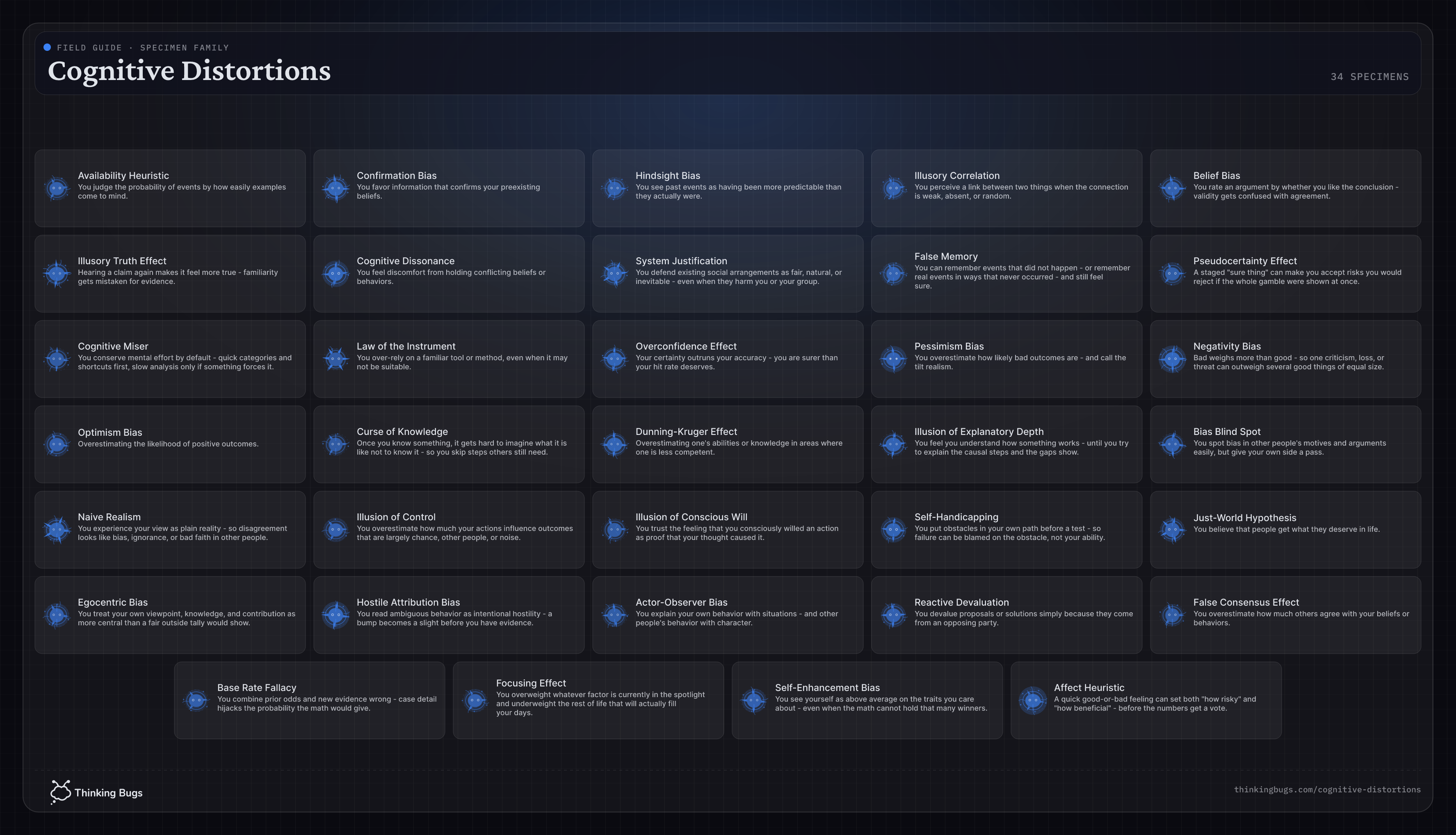

Availability Heuristic
You judge the probability of events by how easily examples come to mind.
59 · Moderate
AvH
Confirmation Bias
You favor information that confirms your preexisting beliefs.
78 · Severe
CB
Hindsight Bias
You see past events as having been more predictable than they actually were.
59 · Moderate
HB
Illusory Correlation
You perceive a link between two things when the connection is weak, absent, or random.
60 · Moderate
IC
Belief Bias
You rate an argument by whether you like the conclusion - validity gets confused with agreement.
68 · High
BB
Illusory Truth Effect
Hearing a claim again makes it feel more true - familiarity gets mistaken for evidence.
79 · Severe
ITE
Barnum Effect
A vague description that could fit almost anyone feels like proof the source uniquely knows you.
57 · Moderate
Bar
Cognitive Dissonance
You feel discomfort from holding conflicting beliefs or behaviors.
69 · High
CD
System Justification
You defend existing social arrangements as fair, natural, or inevitable - even when they harm you or your group.
70 · High
SJ
False Memory
You can remember events that did not happen - or remember real events in ways that never occurred - and still feel sure.
63 · Moderate
FM
Pseudocertainty Effect
A staged "sure thing" can make you accept risks you would reject if the whole gamble were shown at once.
56 · Moderate
PCE
Cognitive Miser
You conserve mental effort by default - quick categories and shortcuts first, slow analysis only if something forces it.
64 · Moderate
CM
Law of the Instrument
You over-rely on a familiar tool or method, even when it may not be suitable.
62 · Moderate
LotI
Overconfidence Effect
Your certainty outruns your accuracy - you are surer than your hit rate deserves.
71 · High
OE
Pessimism Bias
You overestimate how likely bad outcomes are - and call the tilt realism.
65 · Moderate
PB
Negativity Bias
Bad weighs more than good - so one criticism, loss, or threat can outweigh several good things of equal size.
75 · Severe
NB
Optimism Bias
Overestimating the likelihood of positive outcomes.
64 · Moderate
OB
Curse of Knowledge
Once you know something, it gets hard to imagine what it is like not to know it - so you skip steps others still need.
58 · Moderate
CK
Dunning-Kruger Effect
Overestimating one's abilities or knowledge in areas where one is less competent.
73 · High
DKE
Illusion of Explanatory Depth
You feel you understand how something works - until you try to explain the causal steps and the gaps show.
73 · High
IoED
Bias Blind Spot
You spot bias in other people's motives and arguments easily, but give your own side a pass.
68 · High
BBS
Naive Realism
You experience your view as plain reality - so disagreement looks like bias, ignorance, or bad faith in other people.
79 · Severe
NR
Illusion of Control
You overestimate how much your actions influence outcomes that are largely chance, other people, or noise.
60 · Moderate
IoC
Thought-Action Fusion
You treat a thought, or saying it out loud, as if that could make the thing happen - so some topics feel unsafe to touch.
70 · High
TAF
Illusion of Conscious Will
You trust the feeling that you consciously willed an action as proof that your thought caused it.
63 · Moderate
ICW
Self-Handicapping
You put obstacles in your own path before a test - so failure can be blamed on the obstacle, not your ability.
65 · Moderate
SH
Just-World Hypothesis
You believe that people get what they deserve in life.
71 · High
JWH
Egocentric Bias
You treat your own viewpoint, knowledge, and contribution as more central than a fair outside tally would show.
65 · Moderate
EB
Hostile Attribution Bias
You read ambiguous behavior as intentional hostility - a bump becomes a slight before you have evidence.
75 · Severe
HAB
Actor-Observer Bias
You explain your own behavior with situations - and other people's behavior with character.
63 · Moderate
AOB
Reactive Devaluation
You devalue proposals or solutions simply because they come from an opposing party.
66 · High
RD
False Consensus Effect
You overestimate how much others agree with your beliefs or behaviors.
60 · Moderate
FCE
Base Rate Fallacy
You combine prior odds and new evidence wrong - case detail hijacks the probability the math would give.
58 · Moderate
BRF
Focusing Effect
You overweight whatever factor is currently in the spotlight and underweight the rest of life that will actually fill your days.
58 · Moderate
FE
Self-Enhancement Bias
You see yourself as above average on the traits you care about - even when the math cannot hold that many winners.
66 · High
SEB
Affect Heuristic
A quick good-or-bad feeling can set both "how risky" and "how beneficial" - before the numbers get a vote.
69 · High
AH