
Specimen family
n = 28
Digital Distortions
Digital distortions are tech-mediated traps that have become much easier to fall into since the 2000s (and especially after 2020): algorithmic feeds, virality metrics, and AI-generated content can amplify classic biases and make them feel like “new” distortions. Each item below links to a detailed page on this site.
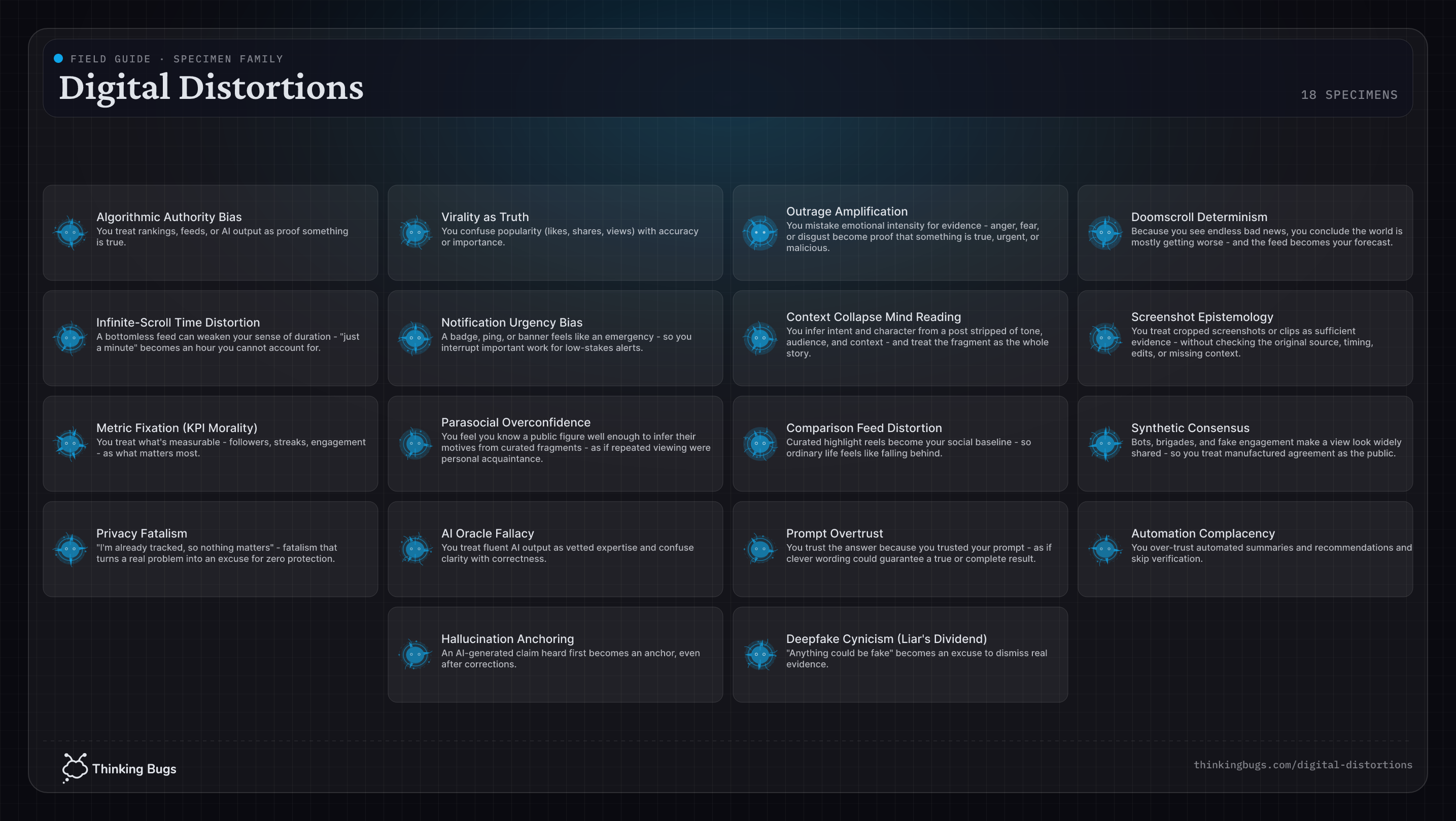

Algorithmic Authority Bias
You treat rankings, feeds, or AI output as proof something is true.
68 · High
AA
Virality as Truth
You confuse popularity (likes, shares, views) with accuracy or importance.
67 · High
VT
Outrage Amplification
You mistake emotional intensity for evidence - anger, fear, or disgust become proof that something is true, urgent, or malicious.
75 · Severe
OA
Doomscroll Determinism
Because you see endless bad news, you conclude the world is mostly getting worse - and the feed becomes your forecast.
70 · High
DD
News-Finds-Me Perception
You assume important news will find you through feeds and friends, so feeling informed replaces going to look.
63 · Moderate
NFM
Infinite-Scroll Time Distortion
A bottomless feed can weaken your sense of duration - "just a minute" becomes an hour you cannot account for.
68 · High
IST
Notification Urgency Bias
A badge, ping, or banner feels like an emergency - so you interrupt important work for low-stakes alerts.
70 · High
NUB
Context Collapse Mind Reading
You infer intent and character from a post stripped of tone, audience, and context - and treat the fragment as the whole story.
65 · Moderate
CC
Reply-Latency Mind Reading
A slow reply, or a fast one, gets read as rejection, anger, or an emergency.
68 · High
RLM
Screenshot Epistemology
You treat cropped screenshots or clips as sufficient evidence - without checking the original source, timing, edits, or missing context.
67 · High
SE
Metric Fixation (KPI Morality)
You treat what's measurable - followers, streaks, engagement - as what matters most.
71 · High
MF
Wearable Verdict
A sleep score, readiness number, or step count matters more than how your body actually feels.
63 · Moderate
WVe
Parasocial Overconfidence
You feel you know a public figure well enough to infer their motives from curated fragments - as if repeated viewing were personal acquaintance.
64 · Moderate
PO
Chatbot Mind Attribution
A warm, fluent chat gets treated as understanding, care, or a promise of confidentiality.
67 · High
CMA
Comparison Feed Distortion
Curated highlight reels become your social baseline - so ordinary life feels like falling behind.
73 · High
CFD
Filtered-Self Standard
The edited photo becomes the face you think the mirror is supposed to match.
70 · High
FSS
Synthetic Consensus
Bots, brigades, and fake engagement make a view look widely shared - so you treat manufactured agreement as the public.
75 · Severe
SyC
Comment Climate Distortion
The people who comment get treated as the public, and their tone gets treated as evidence.
66 · High
CCD
Privacy Fatalism
"I'm already tracked, so nothing matters" - fatalism that turns a real problem into an excuse for zero protection.
67 · High
PrvF
Search Knowledge Illusion
You finish a search and feel the knowledge is now yours, because the answer was easy to reach.
58 · Moderate
SKI
Cyberchondria
A symptom search climbs from an ordinary sensation to a serious disease, and the climb feels like a diagnosis.
69 · High
Cyb
AI Oracle Fallacy
You treat fluent AI output as vetted expertise and confuse clarity with correctness.
66 · High
AO
AI Sycophancy
The model agrees with you, and that agreement feels like an independent second opinion.
65 · Moderate
ASy
Prompt Overtrust
You trust the answer because you trusted your prompt - as if clever wording could guarantee a true or complete result.
64 · Moderate
PrO
Automation Complacency
You over-trust automated summaries and recommendations and skip verification.
64 · Moderate
AC
Hallucination Anchoring
An AI-generated claim heard first becomes an anchor, even after corrections.
62 · Moderate
HA
Deepfake Cynicism (Liar's Dividend)
"Anything could be fake" becomes an excuse to dismiss real evidence.
68 · High
DC
Detection Overconfidence
You trust your own eye to catch fakes and false claims, so you skip the check.
66 · High
DetO