
Specimen family
n = 23
Judgment Errors
Judgment errors are cognitive biases that skew decision-making processes, often leading to incorrect or suboptimal outcomes. These biases influence how we interpret information, make predictions, and assess risks, frequently resulting in flawed judgments that can have significant impacts on our decisions and behaviors. Understanding these errors can help in making more rational and informed decisions, avoiding common pitfalls that many fall into.
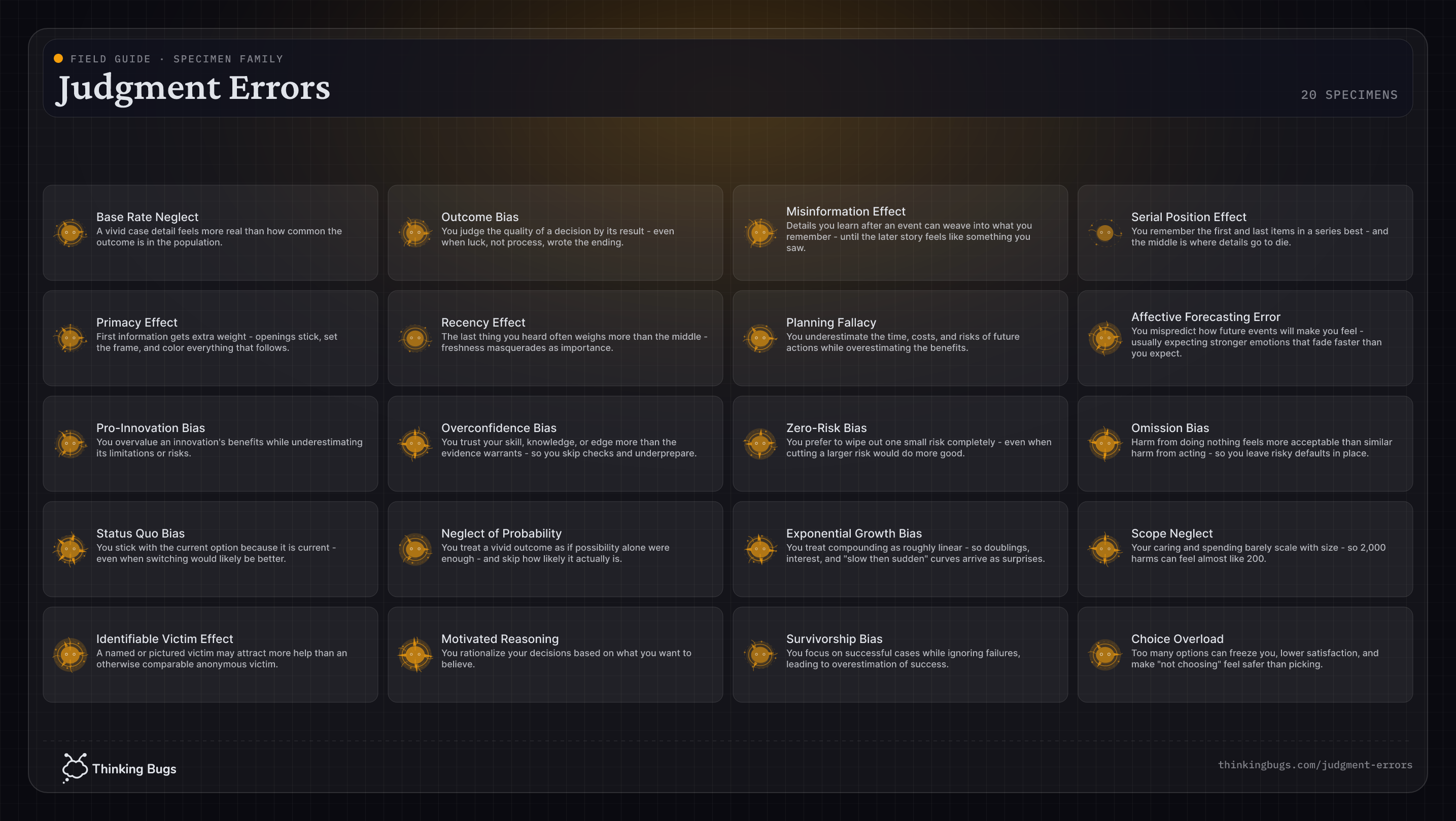

Base Rate Neglect
A vivid case detail feels more real than how common the outcome is in the population.
58 · Moderate
BRN
Outcome Bias
You judge the quality of a decision by its result - even when luck, not process, wrote the ending.
60 · Moderate
OB
Regression to the Mean
An extreme result is followed by a more ordinary one, and you credit whatever happened in between.
65 · Moderate
RtM
Failure Preview
A bad rehearsal starts feeling like proof that the real event will fail, even when the two outcomes may not share a cause.
63 · Moderate
FPv
Misinformation Effect
Details you learn after an event can weave into what you remember - until the later story feels like something you saw.
64 · Moderate
ME
Serial Position Effect
You remember the first and last items in a series best - and the middle is where details go to die.
47 · Mild
SPE
Primacy Effect
First information gets extra weight - openings stick, set the frame, and color everything that follows.
58 · Moderate
PE
Recency Effect
The last thing you heard often weighs more than the middle - freshness masquerades as importance.
52 · Mild
RE
Peak-End Rule
You score a whole experience by its strongest moment and how it ended, then choose as if the rest barely happened.
63 · Moderate
PkE
Planning Fallacy
You underestimate the time, costs, and risks of future actions while overestimating the benefits.
63 · Moderate
PF
Affective Forecasting Error
You mispredict how future events will make you feel - usually expecting stronger emotions that fade faster than you expect.
66 · High
AFE
Pro-Innovation Bias
You overvalue an innovation's benefits while underestimating its limitations or risks.
58 · Moderate
PIB
Overconfidence Bias
You trust your skill, knowledge, or edge more than the evidence warrants - so you skip checks and underprepare.
70 · High
OCB
Zero-Risk Bias
You prefer to wipe out one small risk completely - even when cutting a larger risk would do more good.
60 · Moderate
ZRB
Omission Bias
Harm from doing nothing feels more acceptable than similar harm from acting - so you leave risky defaults in place.
72 · High
OmB
Status Quo Bias
You stick with the current option because it is current - even when switching would likely be better.
74 · High
SQB
Neglect of Probability
You treat a vivid outcome as if possibility alone were enough - and skip how likely it actually is.
62 · Moderate
NP
Exponential Growth Bias
You treat compounding as roughly linear - so doublings, interest, and "slow then sudden" curves arrive as surprises.
69 · High
EGB
Scope Neglect
Your caring and spending barely scale with size - so 2,000 harms can feel almost like 200.
69 · High
ScN
Identifiable Victim Effect
A named or pictured victim may attract more help than an otherwise comparable anonymous victim.
71 · High
IVE
Motivated Reasoning
You rationalize your decisions based on what you want to believe.
78 · Severe
MR
Survivorship Bias
You focus on successful cases while ignoring failures, leading to overestimation of success.
59 · Moderate
SB
Choice Overload
Too many options can freeze you, lower satisfaction, and make "not choosing" feel safer than picking.
60 · Moderate
ChO