Tags at-work · 43 specimens

Thinking Traps at Work

Specimens tagged at work. This tag cuts across specimen families - it is not a family page.

Work amplifies planning errors, status threats, and group pressure. Deadlines, reviews, and meetings make ordinary thinking bugs expensive.

This tag collects specimens that commonly bite in careers, school, and performance culture - from planning fallacy and authority cues to perfectionism and team conformity.

Sort by harm if you want the costliest traps first, or scan for the meeting, review, or project pattern you recognize and open that specimen.
Specimens

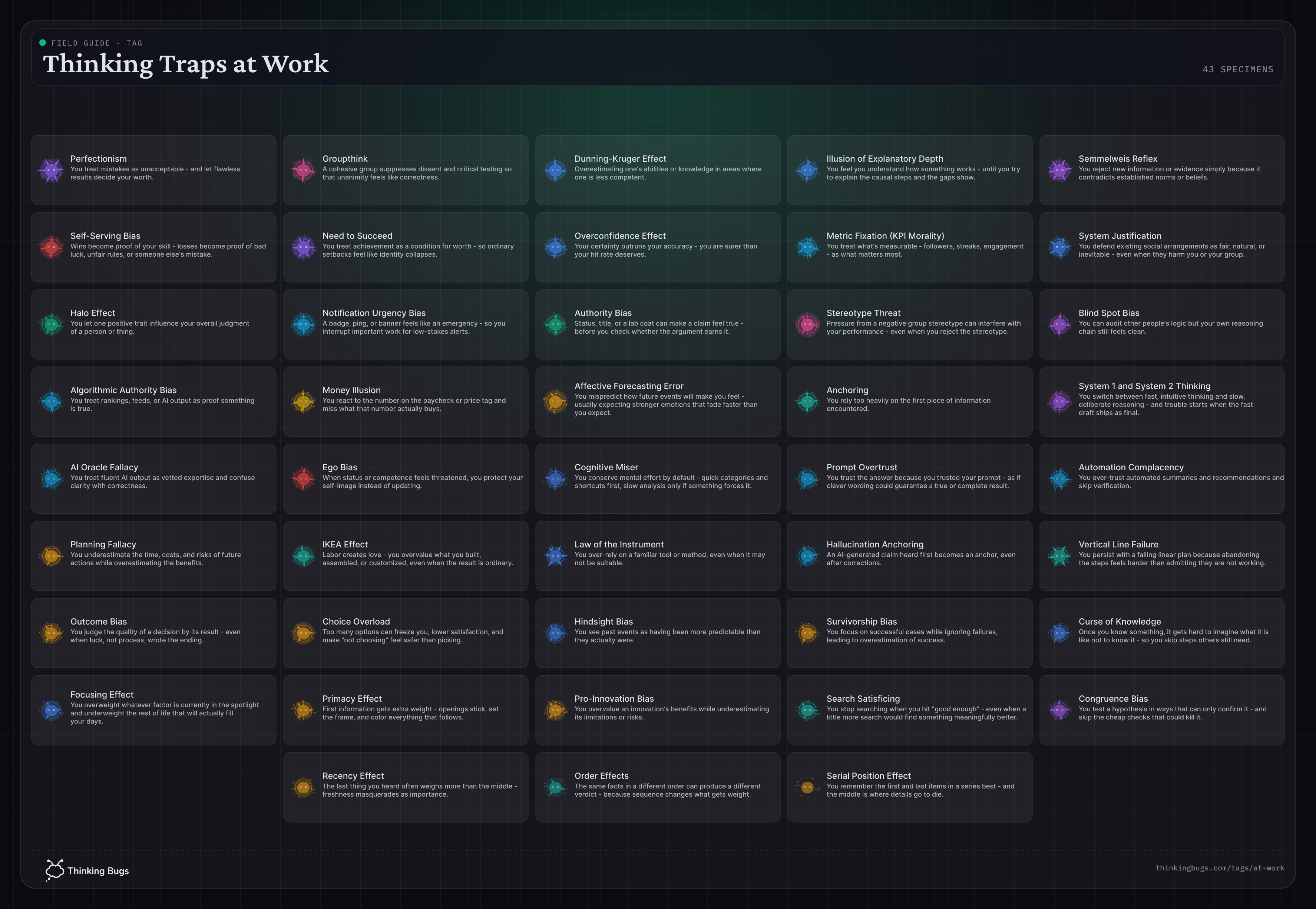
Perfectionism You treat mistakes as unacceptable - and let flawless results decide your worth. 75 · Severe REBT Groupthink A cohesive group suppresses dissent and critical testing so that unanimity feels like correctness. 75 · Severe Social Dunning-Kruger Effect Overestimating one's abilities or knowledge in areas where one is less competent. 73 · High Cognitive Illusion of Explanatory Depth You feel you understand how something works - until you try to explain the causal steps and the gaps show. 73 · High Cognitive Semmelweis Reflex You reject new information or evidence simply because it contradicts established norms or beliefs. 73 · High Reasoning Self-Serving Bias Wins become proof of your skill - losses become proof of bad luck, unfair rules, or someone else's mistake. 72 · High Emotional Need to Succeed You treat achievement as a condition for worth - so ordinary setbacks feel like identity collapses. 71 · High REBT Overconfidence Effect Your certainty outruns your accuracy - you are surer than your hit rate deserves. 71 · High Cognitive Metric Fixation (KPI Morality) You treat what's measurable - followers, streaks, engagement - as what matters most. 71 · High Digital System Justification You defend existing social arrangements as fair, natural, or inevitable - even when they harm you or your group. 70 · High Cognitive Halo Effect You let one positive trait influence your overall judgment of a person or thing. 70 · High Logical Notification Urgency Bias A badge, ping, or banner feels like an emergency - so you interrupt important work for low-stakes alerts. 70 · High Digital Authority Bias Status, title, or a lab coat can make a claim feel true - before you check whether the argument earns it. 68 · High Logical Stereotype Threat Pressure from a negative group stereotype can interfere with your performance - even when you reject the stereotype. 68 · High Social Blind Spot Bias You can audit other people's logic but your own reasoning chain still feels clean. 68 · High Reasoning Algorithmic Authority Bias You treat rankings, feeds, or AI output as proof something is true. 68 · High Digital Money Illusion You react to the number on the paycheck or price tag and miss what that number actually buys. 68 · High Money Affective Forecasting Error You mispredict how future events will make you feel - usually expecting stronger emotions that fade faster than you expect. 66 · High Judgment Anchoring You rely too heavily on the first piece of information encountered. 66 · High Behavioral System 1 and System 2 Thinking You switch between fast, intuitive thinking and slow, deliberate reasoning - and trouble starts when the fast draft ships as final. 66 · High Reasoning AI Oracle Fallacy You treat fluent AI output as vetted expertise and confuse clarity with correctness. 66 · High Digital Ego Bias When status or competence feels threatened, you protect your self-image instead of updating. 65 · Moderate Emotional Cognitive Miser You conserve mental effort by default - quick categories and shortcuts first, slow analysis only if something forces it. 64 · Moderate Cognitive Prompt Overtrust You trust the answer because you trusted your prompt - as if clever wording could guarantee a true or complete result. 64 · Moderate Digital Automation Complacency You over-trust automated summaries and recommendations and skip verification. 64 · Moderate Digital Planning Fallacy You underestimate the time, costs, and risks of future actions while overestimating the benefits. 63 · Moderate Judgment IKEA Effect Labor creates love - you overvalue what you built, assembled, or customized, even when the result is ordinary. 63 · Moderate Behavioral Law of the Instrument You over-rely on a familiar tool or method, even when it may not be suitable. 62 · Moderate Cognitive Hallucination Anchoring An AI-generated claim heard first becomes an anchor, even after corrections. 62 · Moderate Digital Vertical Line Failure You persist with a failing linear plan because abandoning the steps feels harder than admitting they are not working. 61 · Moderate Behavioral Outcome Bias You judge the quality of a decision by its result - even when luck, not process, wrote the ending. 60 · Moderate Judgment Choice Overload Too many options can freeze you, lower satisfaction, and make "not choosing" feel safer than picking. 60 · Moderate Judgment Hindsight Bias You see past events as having been more predictable than they actually were. 59 · Moderate Cognitive Survivorship Bias You focus on successful cases while ignoring failures, leading to overestimation of success. 59 · Moderate Judgment Curse of Knowledge Once you know something, it gets hard to imagine what it is like not to know it - so you skip steps others still need. 58 · Moderate Cognitive Focusing Effect You overweight whatever factor is currently in the spotlight and underweight the rest of life that will actually fill your days. 58 · Moderate Cognitive Primacy Effect First information gets extra weight - openings stick, set the frame, and color everything that follows. 58 · Moderate Judgment Pro-Innovation Bias You overvalue an innovation's benefits while underestimating its limitations or risks. 58 · Moderate Judgment Search Satisficing You stop searching when you hit "good enough" - even when a little more search would find something meaningfully better. 58 · Moderate Behavioral Congruence Bias You test a hypothesis in ways that can only confirm it - and skip the cheap checks that could kill it. 58 · Moderate Reasoning Recency Effect The last thing you heard often weighs more than the middle - freshness masquerades as importance. 52 · Mild Judgment Order Effects The same facts in a different order can produce a different verdict - because sequence changes what gets weight. 51 · Mild Behavioral Serial Position Effect You remember the first and last items in a series best - and the middle is where details go to die. 47 · Mild Judgment