Tags procrastination · 11 specimens

Procrastination and Avoidance

Specimens tagged procrastination. This tag cuts across specimen families - it is not a family page.

Procrastination and avoidance often protect you from short-term discomfort while growing the long-term cost. The thinking that makes delay feel necessary is the specimen - not laziness as a character trait.

Related bugs include discomfort avoidance, ostriching hard facts, status-quo stickiness, present bias, planning fallacy, and choice overload. Money, work, and feeds all amplify the same dodge.

Use the list to name the story behind the stall, then open a specimen for a smaller next action than the one you’ve been avoiding.
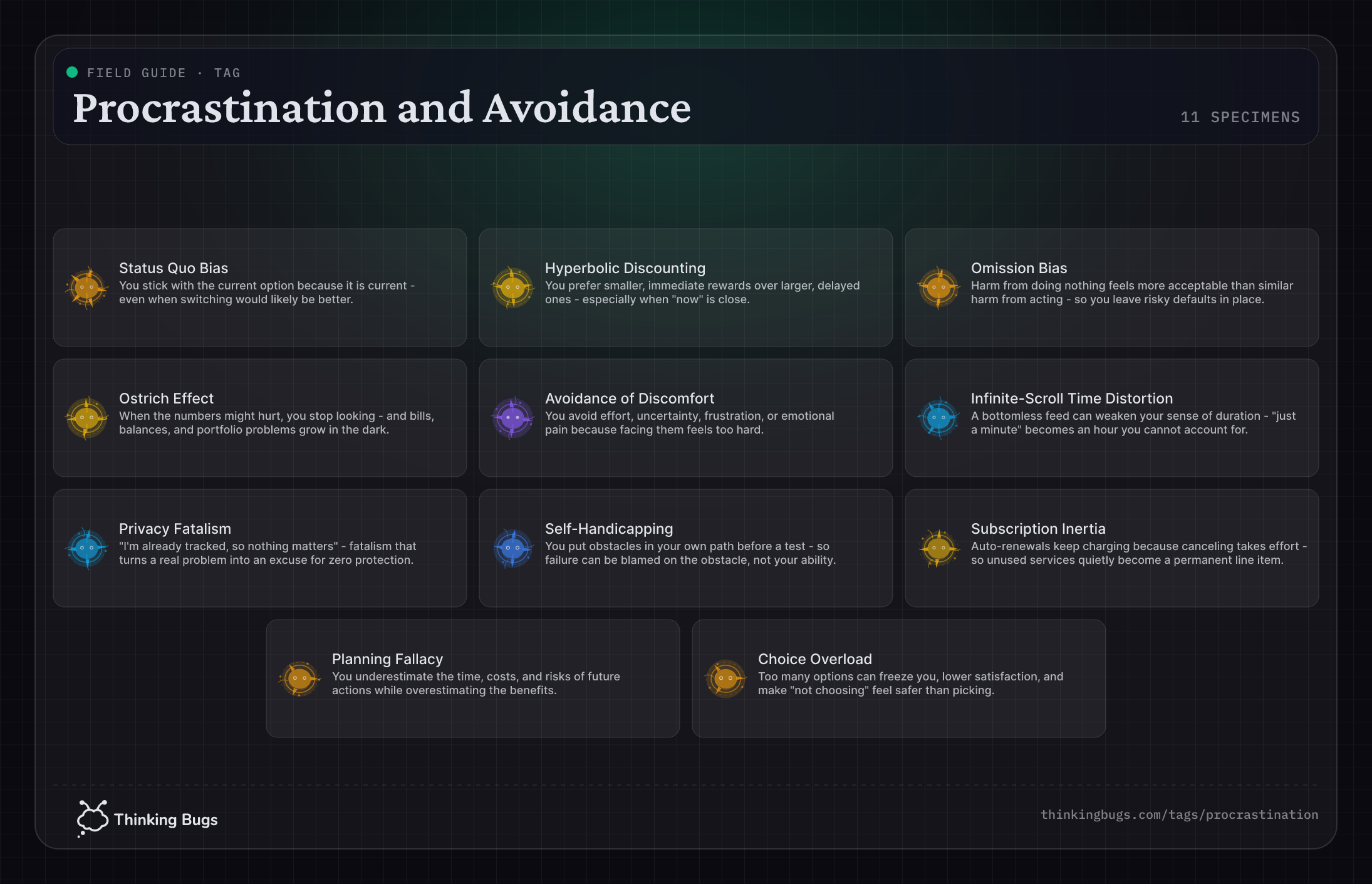
Specimens

Status Quo Bias You stick with the current option because it is current - even when switching would likely be better. 74 · High Judgment Hyperbolic Discounting You prefer smaller, immediate rewards over larger, delayed ones - especially when "now" is close. 74 · High Money Omission Bias Harm from doing nothing feels more acceptable than similar harm from acting - so you leave risky defaults in place. 72 · High Judgment Ostrich Effect When the numbers might hurt, you stop looking - and bills, balances, and portfolio problems grow in the dark. 72 · High Money Avoidance of Discomfort You avoid effort, uncertainty, frustration, or emotional pain because facing them feels too hard. 69 · High REBT Infinite-Scroll Time Distortion A bottomless feed can weaken your sense of duration - "just a minute" becomes an hour you cannot account for. 68 · High Digital Privacy Fatalism "I'm already tracked, so nothing matters" - fatalism that turns a real problem into an excuse for zero protection. 67 · High Digital Self-Handicapping You put obstacles in your own path before a test - so failure can be blamed on the obstacle, not your ability. 65 · Moderate Cognitive Subscription Inertia Auto-renewals keep charging because canceling takes effort - so unused services quietly become a permanent line item. 64 · Moderate Money Planning Fallacy You underestimate the time, costs, and risks of future actions while overestimating the benefits. 63 · Moderate Judgment Choice Overload Too many options can freeze you, lower satisfaction, and make "not choosing" feel safer than picking. 60 · Moderate Judgment