Tags thinking-errors · 24 specimens

Thinking Errors

Specimens tagged thinking errors. This tag cuts across specimen families - it is not a family page.

Thinking errors are correctable mistakes in judgment and self-talk - the kind you can name, test, and reframe.

This page lists matching specimens from CBT, REBT, and neighboring families. It is a search-intent list, not the CBT Thinking Errors family page (which is the taxonomy home for that set).

Use the harm index to start with the bugs that bite hardest, then open a specimen for examples, impact, and a concrete counter-move.

Related specimen family: CBT Thinking Errors (taxonomy page - not this tag list).
Specimens

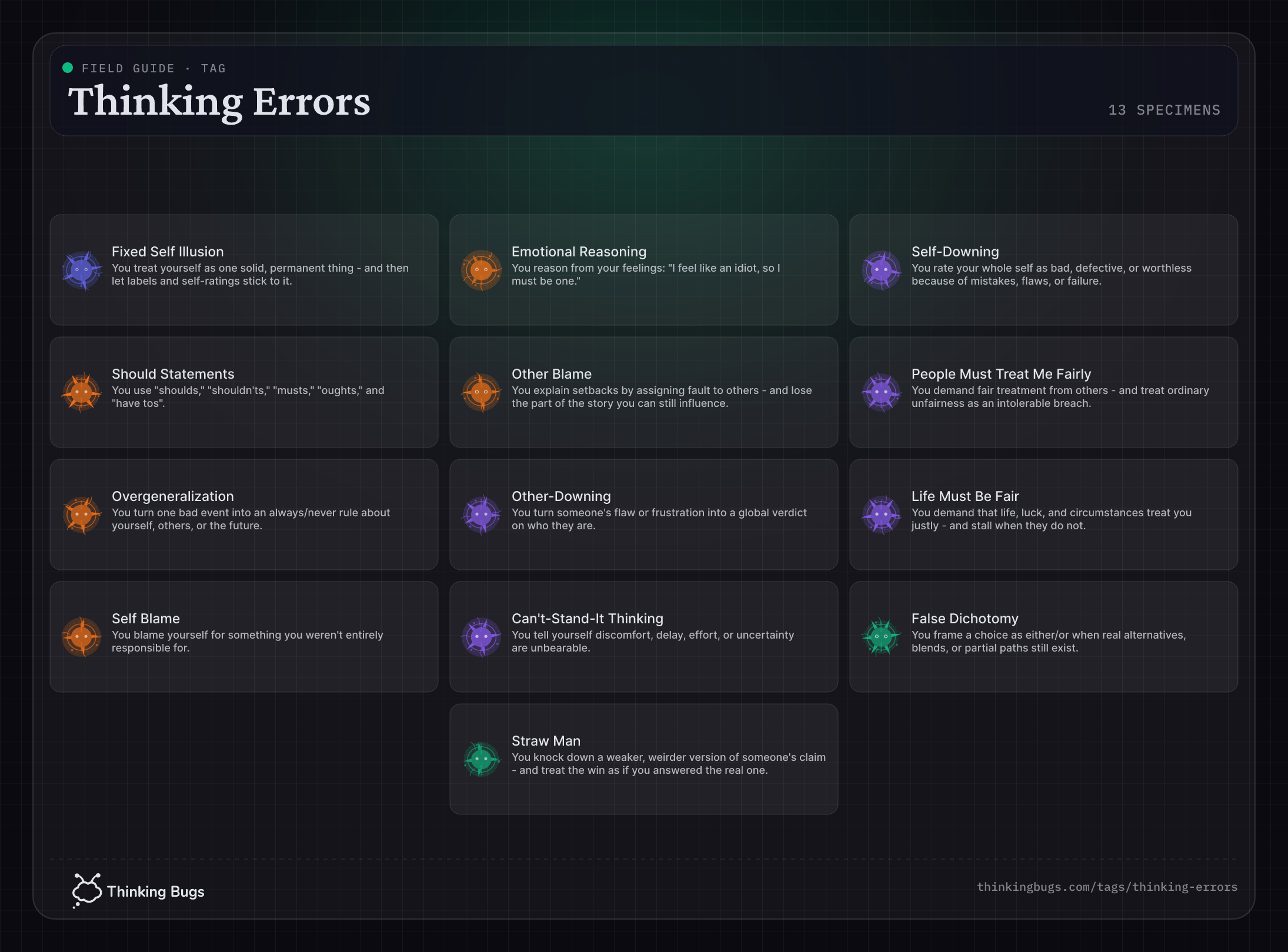
Fixed Self Illusion You treat yourself as one solid, permanent thing - and then let labels and self-ratings stick to it. 77 · Severe Perceptual Emotional Reasoning You reason from your feelings: "I feel like an idiot, so I must be one." 72 · High CBT Self-Downing You rate your whole self as bad, defective, or worthless because of mistakes, flaws, or failure. 72 · High REBT Should Statements You use "shoulds," "shouldn'ts," "musts," "oughts," and "have tos". 71 · High CBT Other Blame You explain setbacks by assigning fault to others - and lose the part of the story you can still influence. 69 · High CBT People Must Treat Me Fairly You demand fair treatment from others - and treat ordinary unfairness as an intolerable breach. 69 · High REBT Overgeneralization You turn one bad event into an always/never rule about yourself, others, or the future. 68 · High CBT Other-Downing You turn someone's flaw or frustration into a global verdict on who they are. 68 · High REBT Life Must Be Fair You demand that life, luck, and circumstances treat you justly - and stall when they do not. 67 · High REBT Self Blame You blame yourself for something you weren't entirely responsible for. 66 · High CBT Can't-Stand-It Thinking You tell yourself discomfort, delay, effort, or uncertainty are unbearable. 66 · High REBT Whataboutism (Tu Quoque) A charge is met by a different charge, and the first one never gets an answer. 66 · High Logical False Dichotomy You frame a choice as either/or when real alternatives, blends, or partial paths still exist. 65 · Moderate Logical Motte-and-Bailey Fallacy Under questioning, the bold claim hides behind a modest one. When the questions stop, the bold claim is back. 65 · Moderate Logical Moving the Goalposts The evidence you asked for arrives, and the standard for proof moves so you still do not have to update. 64 · Moderate Logical Special Pleading You keep the rule, and you quietly excuse the case you care about from having to follow it. 64 · Moderate Logical Ad Hominem You answer the person instead of the claim, and treat that answer as if the claim lost. 62 · Moderate Logical No True Scotsman A counterexample shows up, and the category quietly shrinks so the counterexample is no longer inside it. 62 · Moderate Logical Anecdotal Evidence One vivid story gets treated as if it were a rate, a study, or a reason to ignore the table. 62 · Moderate Logical Nirvana Fallacy A real option gets rejected because it is not the perfect option, so the comparison that matters never happens. 61 · Moderate Logical Straw Man You knock down a weaker, weirder version of someone's claim - and treat the win as if you answered the real one. 60 · Moderate Logical Gish Gallop A stack of weak points arrives faster than anyone can answer, and the unanswered stack is treated as a win. 59 · Moderate Logical Appeal to Nature "It's natural" gets used as a verdict, as if nature had already done the ethics and the safety check. 58 · Moderate Logical Red Herring Fallacy The reply is vivid, and it answers a question nobody asked, so the original question leaves the room. 56 · Moderate Logical