Tags cognitive-biases · 38 specimens

Cognitive Biases

Specimens tagged cognitive biases. This tag cuts across specimen families - it is not a family page.

Cognitive biases are systematic judgment shortcuts - patterns research has named because they keep showing up across people, not because one person is uniquely irrational.

This page is a curated cross-family list of classic bias specimens (not every bug on the site). For the site’s Cognitive Distortions taxonomy page - a different organizing cut - use that family page instead.

Browse by harm index, then open a specimen for how the bias feels in the moment, where it shows up, and what to try instead.

Related specimen family: Cognitive Distortions (taxonomy page - not this tag list).
Specimens

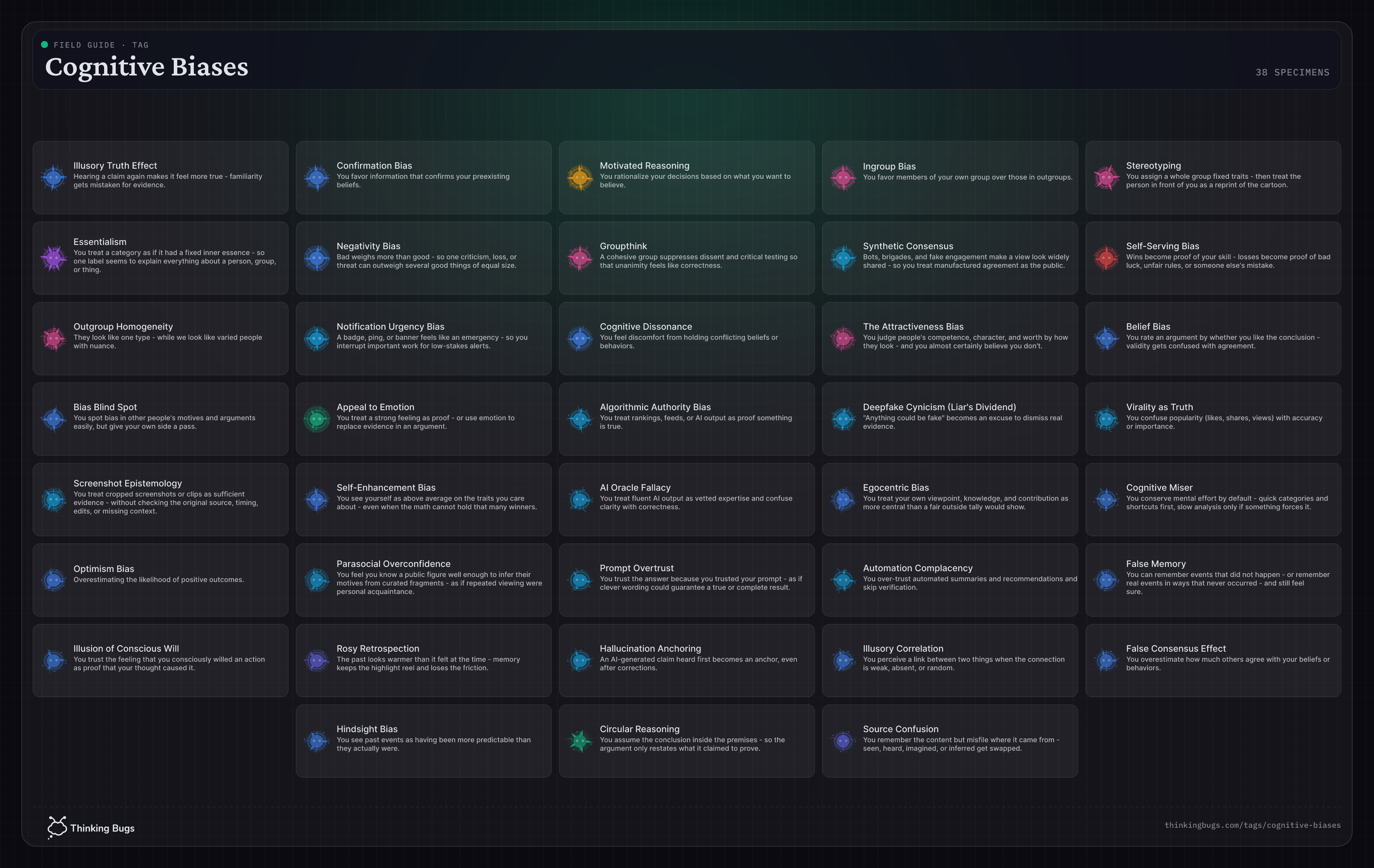
Illusory Truth Effect Hearing a claim again makes it feel more true - familiarity gets mistaken for evidence. 79 · Severe Cognitive Confirmation Bias You favor information that confirms your preexisting beliefs. 78 · Severe Cognitive Motivated Reasoning You rationalize your decisions based on what you want to believe. 78 · Severe Judgment Ingroup Bias You favor members of your own group over those in outgroups. 77 · Severe Social Stereotyping You assign a whole group fixed traits - then treat the person in front of you as a reprint of the cartoon. 77 · Severe Social Essentialism You treat a category as if it had a fixed inner essence - so one label seems to explain everything about a person, group, or thing. 77 · Severe Reasoning Negativity Bias Bad weighs more than good - so one criticism, loss, or threat can outweigh several good things of equal size. 75 · Severe Cognitive Groupthink A cohesive group suppresses dissent and critical testing so that unanimity feels like correctness. 75 · Severe Social Synthetic Consensus Bots, brigades, and fake engagement make a view look widely shared - so you treat manufactured agreement as the public. 75 · Severe Digital Self-Serving Bias Wins become proof of your skill - losses become proof of bad luck, unfair rules, or someone else's mistake. 72 · High Emotional Outgroup Homogeneity They look like one type - while we look like varied people with nuance. 70 · High Social Notification Urgency Bias A badge, ping, or banner feels like an emergency - so you interrupt important work for low-stakes alerts. 70 · High Digital Cognitive Dissonance You feel discomfort from holding conflicting beliefs or behaviors. 69 · High Cognitive The Attractiveness Bias You judge people's competence, character, and worth by how they look - and you almost certainly believe you don't. 69 · High Social Belief Bias You rate an argument by whether you like the conclusion - validity gets confused with agreement. 68 · High Cognitive Bias Blind Spot You spot bias in other people's motives and arguments easily, but give your own side a pass. 68 · High Cognitive Appeal to Emotion You treat a strong feeling as proof - or use emotion to replace evidence in an argument. 68 · High Logical Algorithmic Authority Bias You treat rankings, feeds, or AI output as proof something is true. 68 · High Digital Deepfake Cynicism (Liar's Dividend) "Anything could be fake" becomes an excuse to dismiss real evidence. 68 · High Digital Virality as Truth You confuse popularity (likes, shares, views) with accuracy or importance. 67 · High Digital Screenshot Epistemology You treat cropped screenshots or clips as sufficient evidence - without checking the original source, timing, edits, or missing context. 67 · High Digital Self-Enhancement Bias You see yourself as above average on the traits you care about - even when the math cannot hold that many winners. 66 · High Cognitive AI Oracle Fallacy You treat fluent AI output as vetted expertise and confuse clarity with correctness. 66 · High Digital Egocentric Bias You treat your own viewpoint, knowledge, and contribution as more central than a fair outside tally would show. 65 · Moderate Cognitive Cognitive Miser You conserve mental effort by default - quick categories and shortcuts first, slow analysis only if something forces it. 64 · Moderate Cognitive Optimism Bias Overestimating the likelihood of positive outcomes. 64 · Moderate Cognitive Parasocial Overconfidence You feel you know a public figure well enough to infer their motives from curated fragments - as if repeated viewing were personal acquaintance. 64 · Moderate Digital Prompt Overtrust You trust the answer because you trusted your prompt - as if clever wording could guarantee a true or complete result. 64 · Moderate Digital Automation Complacency You over-trust automated summaries and recommendations and skip verification. 64 · Moderate Digital False Memory You can remember events that did not happen - or remember real events in ways that never occurred - and still feel sure. 63 · Moderate Cognitive Illusion of Conscious Will You trust the feeling that you consciously willed an action as proof that your thought caused it. 63 · Moderate Cognitive Rosy Retrospection The past looks warmer than it felt at the time - memory keeps the highlight reel and loses the friction. 62 · Moderate Perceptual Hallucination Anchoring An AI-generated claim heard first becomes an anchor, even after corrections. 62 · Moderate Digital Illusory Correlation You perceive a link between two things when the connection is weak, absent, or random. 60 · Moderate Cognitive False Consensus Effect You overestimate how much others agree with your beliefs or behaviors. 60 · Moderate Cognitive Hindsight Bias You see past events as having been more predictable than they actually were. 59 · Moderate Cognitive Circular Reasoning You assume the conclusion inside the premises - so the argument only restates what it claimed to prove. 55 · Mild Logical Source Confusion You remember the content but misfile where it came from - seen, heard, imagined, or inferred get swapped. 55 · Mild Perceptual