Tags groups · 33 specimens

Group Decision Traps

Specimens tagged groups. This tag cuts across specimen families - it is not a family page.

Groups can sharpen thinking - or silence dissent. Belonging, status, and shared stories change what feels sayable and what counts as “obvious.”

This tag collects conformity, stereotyping, attribution, and related social traps. The Social Thinking Traps family page is the taxonomy twin for that set.

Browse when a team, crowd, or tribe is making you more sure than the evidence warrants - then open a specimen for how the pressure works and how to push back.

Related specimen family: Social Thinking Traps (taxonomy page - not this tag list).
Specimens

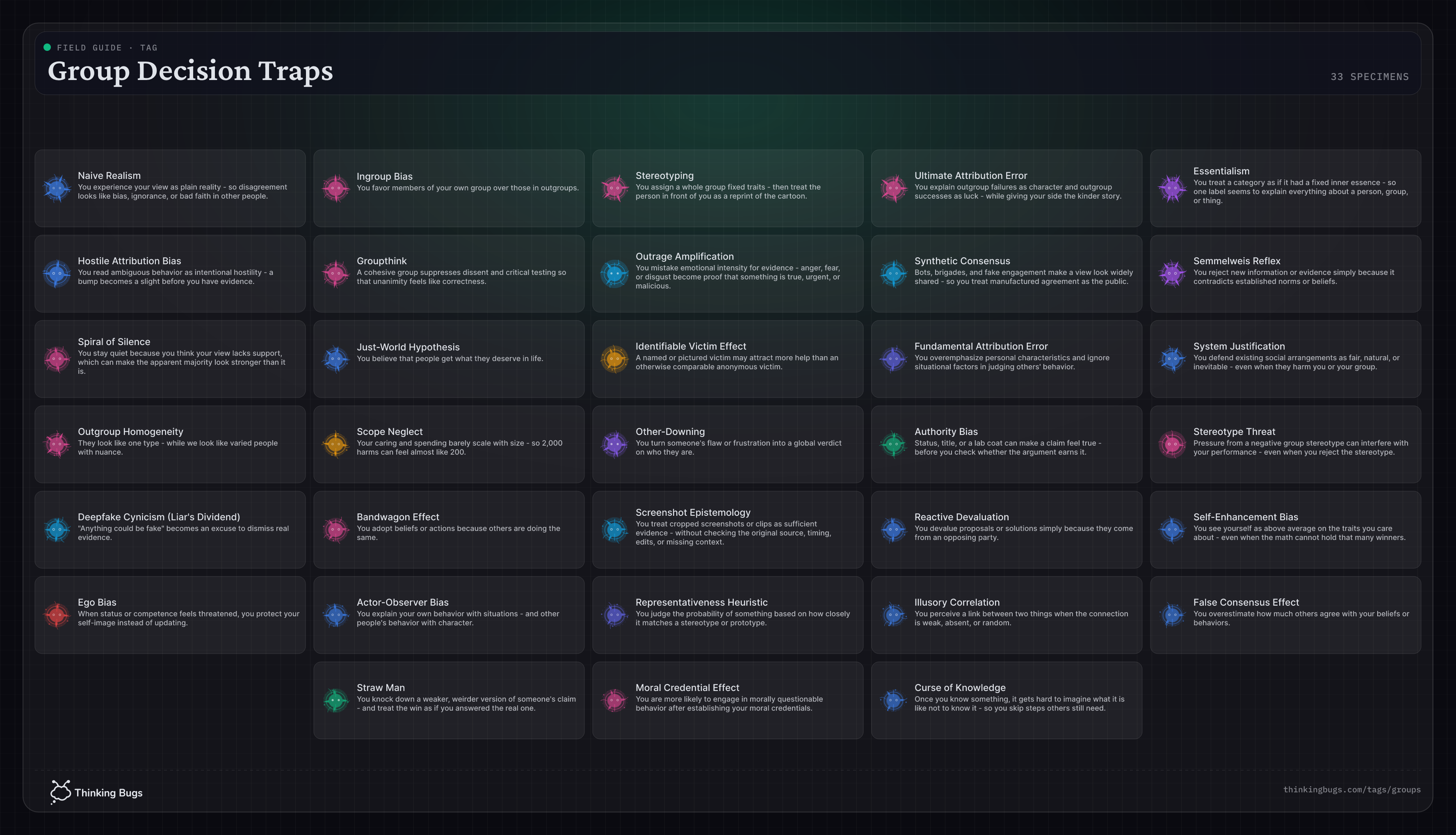
Naive Realism You experience your view as plain reality - so disagreement looks like bias, ignorance, or bad faith in other people. 79 · Severe Cognitive Ingroup Bias You favor members of your own group over those in outgroups. 77 · Severe Social Stereotyping You assign a whole group fixed traits - then treat the person in front of you as a reprint of the cartoon. 77 · Severe Social Ultimate Attribution Error You explain outgroup failures as character and outgroup successes as luck - while giving your side the kinder story. 77 · Severe Social Essentialism You treat a category as if it had a fixed inner essence - so one label seems to explain everything about a person, group, or thing. 77 · Severe Reasoning Hostile Attribution Bias You read ambiguous behavior as intentional hostility - a bump becomes a slight before you have evidence. 75 · Severe Cognitive Groupthink A cohesive group suppresses dissent and critical testing so that unanimity feels like correctness. 75 · Severe Social Outrage Amplification You mistake emotional intensity for evidence - anger, fear, or disgust become proof that something is true, urgent, or malicious. 75 · Severe Digital Synthetic Consensus Bots, brigades, and fake engagement make a view look widely shared - so you treat manufactured agreement as the public. 75 · Severe Digital Semmelweis Reflex You reject new information or evidence simply because it contradicts established norms or beliefs. 73 · High Reasoning Spiral of Silence You stay quiet because you think your view lacks support, which can make the apparent majority look stronger than it is. 72 · High Social Just-World Hypothesis You believe that people get what they deserve in life. 71 · High Cognitive Identifiable Victim Effect A named or pictured victim may attract more help than an otherwise comparable anonymous victim. 71 · High Judgment Fundamental Attribution Error You overemphasize personal characteristics and ignore situational factors in judging others' behavior. 71 · High Perceptual System Justification You defend existing social arrangements as fair, natural, or inevitable - even when they harm you or your group. 70 · High Cognitive Outgroup Homogeneity They look like one type - while we look like varied people with nuance. 70 · High Social Scope Neglect Your caring and spending barely scale with size - so 2,000 harms can feel almost like 200. 69 · High Judgment Other-Downing You turn someone's flaw or frustration into a global verdict on who they are. 68 · High REBT Authority Bias Status, title, or a lab coat can make a claim feel true - before you check whether the argument earns it. 68 · High Logical Stereotype Threat Pressure from a negative group stereotype can interfere with your performance - even when you reject the stereotype. 68 · High Social Deepfake Cynicism (Liar's Dividend) "Anything could be fake" becomes an excuse to dismiss real evidence. 68 · High Digital Bandwagon Effect You adopt beliefs or actions because others are doing the same. 67 · High Social Screenshot Epistemology You treat cropped screenshots or clips as sufficient evidence - without checking the original source, timing, edits, or missing context. 67 · High Digital Reactive Devaluation You devalue proposals or solutions simply because they come from an opposing party. 66 · High Cognitive Self-Enhancement Bias You see yourself as above average on the traits you care about - even when the math cannot hold that many winners. 66 · High Cognitive Ego Bias When status or competence feels threatened, you protect your self-image instead of updating. 65 · Moderate Emotional Actor-Observer Bias You explain your own behavior with situations - and other people's behavior with character. 63 · Moderate Cognitive Representativeness Heuristic You judge the probability of something based on how closely it matches a stereotype or prototype. 63 · Moderate Perceptual Illusory Correlation You perceive a link between two things when the connection is weak, absent, or random. 60 · Moderate Cognitive False Consensus Effect You overestimate how much others agree with your beliefs or behaviors. 60 · Moderate Cognitive Straw Man You knock down a weaker, weirder version of someone's claim - and treat the win as if you answered the real one. 60 · Moderate Logical Moral Credential Effect You are more likely to engage in morally questionable behavior after establishing your moral credentials. 59 · Moderate Social Curse of Knowledge Once you know something, it gets hard to imagine what it is like not to know it - so you skip steps others still need. 58 · Moderate Cognitive