Tags social-media · 35 specimens

Social Media Bias

Specimens tagged social media. This tag cuts across specimen families - it is not a family page.

Feeds reward speed, emotion, and social proof. Comparison, outrage, and illusory consensus get cheaper to produce than careful update.

This tag is about online life across families. The Digital Distortions family is the taxonomy home for screen-native specimens; many classic biases also intensify on feeds.

Use the list when a scroll session leaves you certain, ashamed, or escalated - then open the matching specimen for how the mechanism works offline and on.

Related specimen family: Digital Distortions (taxonomy page - not this tag list).
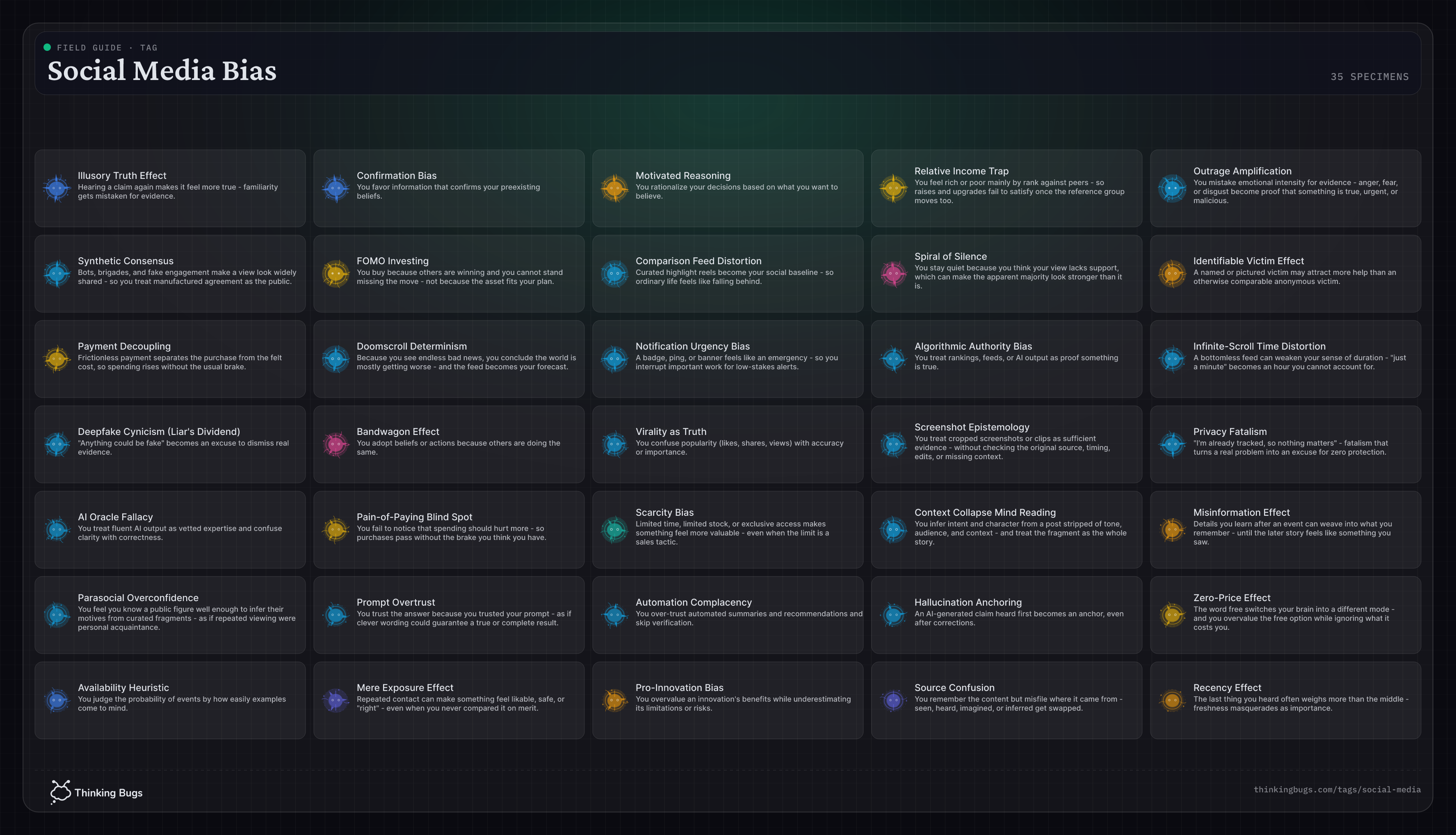
Specimens

Illusory Truth Effect Hearing a claim again makes it feel more true - familiarity gets mistaken for evidence. 79 · Severe Cognitive Confirmation Bias You favor information that confirms your preexisting beliefs. 78 · Severe Cognitive Motivated Reasoning You rationalize your decisions based on what you want to believe. 78 · Severe Judgment Relative Income Trap You feel rich or poor mainly by rank against peers - so raises and upgrades fail to satisfy once the reference group moves too. 78 · Severe Money Outrage Amplification You mistake emotional intensity for evidence - anger, fear, or disgust become proof that something is true, urgent, or malicious. 75 · Severe Digital Synthetic Consensus Bots, brigades, and fake engagement make a view look widely shared - so you treat manufactured agreement as the public. 75 · Severe Digital FOMO Investing You buy because others are winning and you cannot stand missing the move - not because the asset fits your plan. 75 · Severe Money Comparison Feed Distortion Curated highlight reels become your social baseline - so ordinary life feels like falling behind. 73 · High Digital Spiral of Silence You stay quiet because you think your view lacks support, which can make the apparent majority look stronger than it is. 72 · High Social Identifiable Victim Effect A named or pictured victim may attract more help than an otherwise comparable anonymous victim. 71 · High Judgment Payment Decoupling Frictionless payment separates the purchase from the felt cost, so spending rises without the usual brake. 71 · High Money Doomscroll Determinism Because you see endless bad news, you conclude the world is mostly getting worse - and the feed becomes your forecast. 70 · High Digital Notification Urgency Bias A badge, ping, or banner feels like an emergency - so you interrupt important work for low-stakes alerts. 70 · High Digital Algorithmic Authority Bias You treat rankings, feeds, or AI output as proof something is true. 68 · High Digital Infinite-Scroll Time Distortion A bottomless feed can weaken your sense of duration - "just a minute" becomes an hour you cannot account for. 68 · High Digital Deepfake Cynicism (Liar's Dividend) "Anything could be fake" becomes an excuse to dismiss real evidence. 68 · High Digital Bandwagon Effect You adopt beliefs or actions because others are doing the same. 67 · High Social Virality as Truth You confuse popularity (likes, shares, views) with accuracy or importance. 67 · High Digital Screenshot Epistemology You treat cropped screenshots or clips as sufficient evidence - without checking the original source, timing, edits, or missing context. 67 · High Digital Privacy Fatalism "I'm already tracked, so nothing matters" - fatalism that turns a real problem into an excuse for zero protection. 67 · High Digital AI Oracle Fallacy You treat fluent AI output as vetted expertise and confuse clarity with correctness. 66 · High Digital Pain-of-Paying Blind Spot You fail to notice that spending should hurt more - so purchases pass without the brake you think you have. 66 · High Money Scarcity Bias Limited time, limited stock, or exclusive access makes something feel more valuable - even when the limit is a sales tactic. 65 · Moderate Behavioral Context Collapse Mind Reading You infer intent and character from a post stripped of tone, audience, and context - and treat the fragment as the whole story. 65 · Moderate Digital Misinformation Effect Details you learn after an event can weave into what you remember - until the later story feels like something you saw. 64 · Moderate Judgment Parasocial Overconfidence You feel you know a public figure well enough to infer their motives from curated fragments - as if repeated viewing were personal acquaintance. 64 · Moderate Digital Prompt Overtrust You trust the answer because you trusted your prompt - as if clever wording could guarantee a true or complete result. 64 · Moderate Digital Automation Complacency You over-trust automated summaries and recommendations and skip verification. 64 · Moderate Digital Hallucination Anchoring An AI-generated claim heard first becomes an anchor, even after corrections. 62 · Moderate Digital Zero-Price Effect The word free switches your brain into a different mode - and you overvalue the free option while ignoring what it costs you. 61 · Moderate Money Availability Heuristic You judge the probability of events by how easily examples come to mind. 59 · Moderate Cognitive Mere Exposure Effect Repeated contact can make something feel likable, safe, or "right" - even when you never compared it on merit. 59 · Moderate Perceptual Pro-Innovation Bias You overvalue an innovation's benefits while underestimating its limitations or risks. 58 · Moderate Judgment Source Confusion You remember the content but misfile where it came from - seen, heard, imagined, or inferred get swapped. 55 · Mild Perceptual Recency Effect The last thing you heard often weighs more than the middle - freshness masquerades as importance. 52 · Mild Judgment