Tags overthinking · 17 specimens

Overthinking

Specimens tagged overthinking. This tag cuts across specimen families - it is not a family page.

Overthinking is when analysis and worry keep spinning past useful action. The mind treats more thought as more safety - then the loop itself becomes the problem.

Related specimens include fortune-telling, intolerance of uncertainty, motivated reasoning, and other prediction or rumination traps. They share a move: separate the story from the evidence, then choose a next action small enough to exit the spin.

This is not a diagnosis page. It is a field guide to thinking bugs that commonly fuel overthinking.
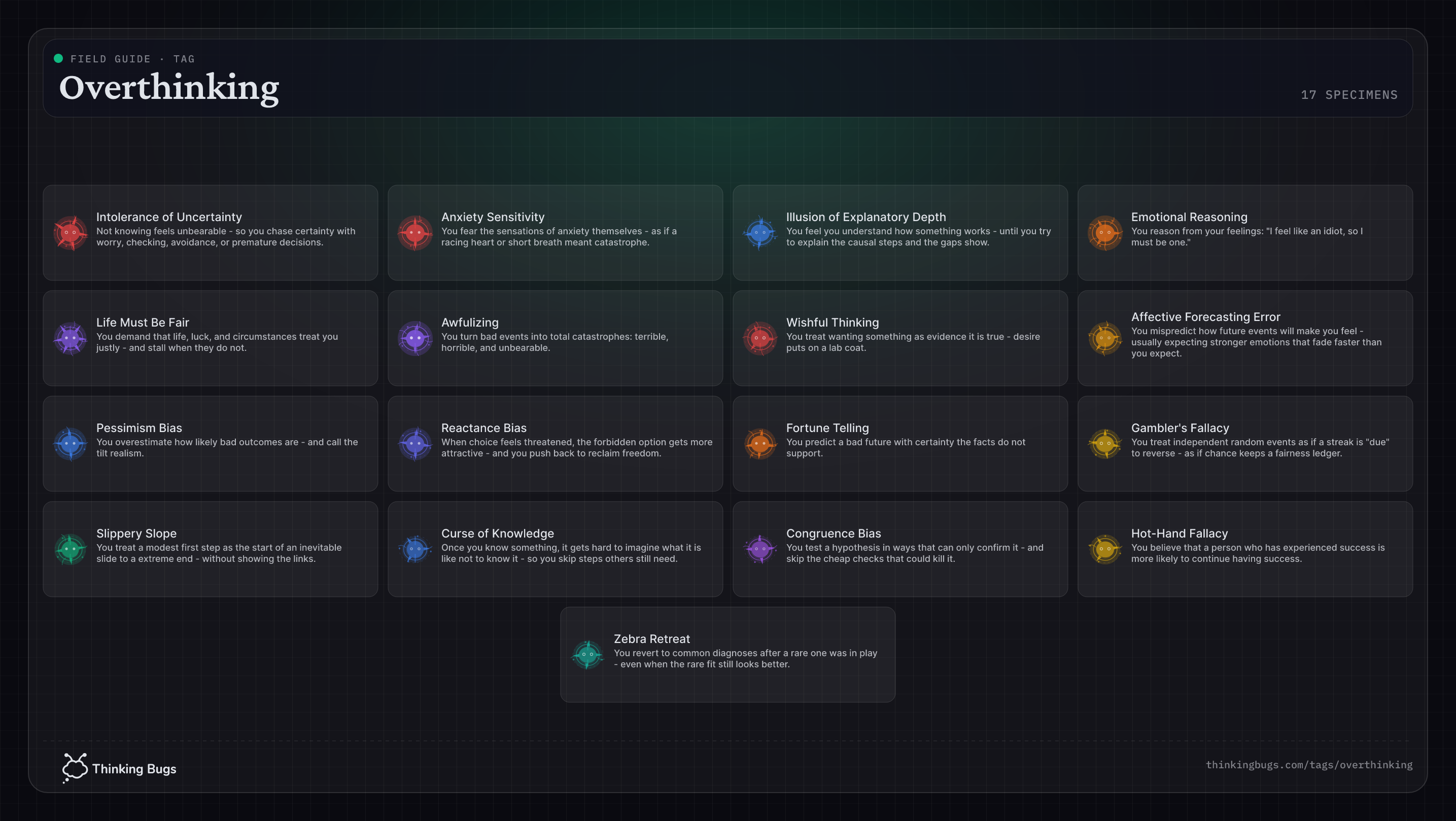
Specimens

Intolerance of Uncertainty Not knowing feels unbearable - so you chase certainty with worry, checking, avoidance, or premature decisions. 77 · Severe Emotional Anxiety Sensitivity You fear the sensations of anxiety themselves - as if a racing heart or short breath meant catastrophe. 74 · High Emotional Illusion of Explanatory Depth You feel you understand how something works - until you try to explain the causal steps and the gaps show. 73 · High Cognitive Emotional Reasoning You reason from your feelings: "I feel like an idiot, so I must be one." 72 · High CBT Life Must Be Fair You demand that life, luck, and circumstances treat you justly - and stall when they do not. 67 · High REBT Awfulizing You turn bad events into total catastrophes: terrible, horrible, and unbearable. 67 · High REBT Wishful Thinking You treat wanting something as evidence it is true - desire puts on a lab coat. 67 · High Emotional Affective Forecasting Error You mispredict how future events will make you feel - usually expecting stronger emotions that fade faster than you expect. 66 · High Judgment Pessimism Bias You overestimate how likely bad outcomes are - and call the tilt realism. 65 · Moderate Cognitive Reactance Bias When choice feels threatened, the forbidden option gets more attractive - and you push back to reclaim freedom. 65 · Moderate Perceptual Fortune Telling You predict a bad future with certainty the facts do not support. 63 · Moderate CBT Gambler's Fallacy You treat independent random events as if a streak is "due" to reverse - as if chance keeps a fairness ledger. 60 · Moderate Money Slippery Slope You treat a modest first step as the start of an inevitable slide to a extreme end - without showing the links. 59 · Moderate Logical Curse of Knowledge Once you know something, it gets hard to imagine what it is like not to know it - so you skip steps others still need. 58 · Moderate Cognitive Congruence Bias You test a hypothesis in ways that can only confirm it - and skip the cheap checks that could kill it. 58 · Moderate Reasoning Hot-Hand Fallacy You believe that a person who has experienced success is more likely to continue having success. 58 · Moderate Money Zebra Retreat You revert to common diagnoses after a rare one was in play - even when the rare fit still looks better. 57 · Moderate Behavioral