Tags decision-biases · 74 specimens

Decision-Making Biases

Specimens tagged decision biases. This tag cuts across specimen families - it is not a family page.

Decision biases show up when you pick, delay, commit, or walk away - especially under risk, incomplete information, or time pressure.

This tag is about choice under uncertainty. It overlaps the Judgment Errors family but is not the same page: the family is a taxonomy home; this page is a cross-family list.

Start with high-harm specimens if you want the costliest traps first, or scan for familiar situations (money, work, forecasts) and drill into those articles.

Related specimen family: Judgment Errors (taxonomy page - not this tag list).
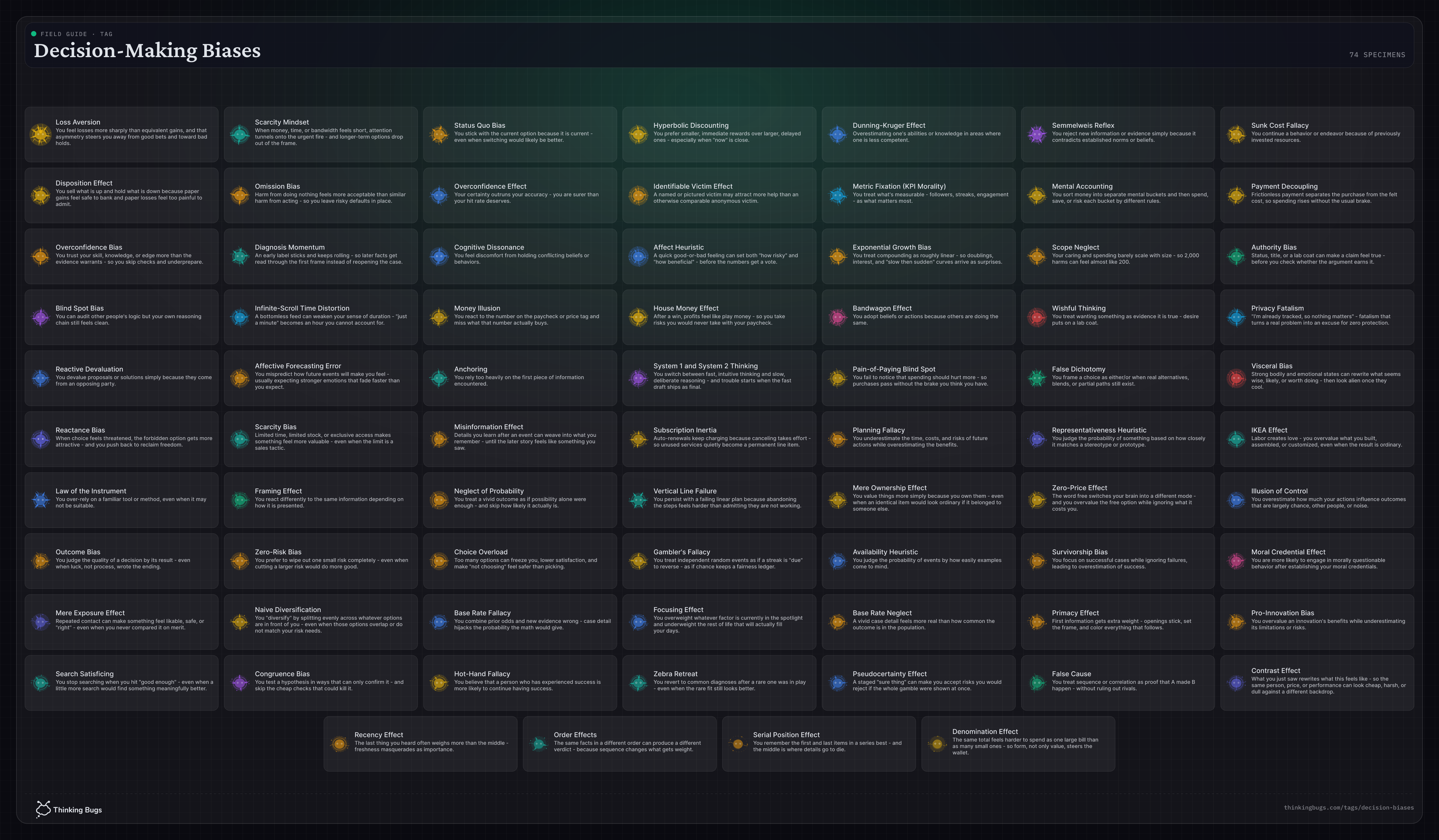
Specimens

Loss Aversion You feel losses more sharply than equivalent gains, and that asymmetry steers you away from good bets and toward bad holds. 81 · Severe Money Scarcity Mindset When money, time, or bandwidth feels short, attention tunnels onto the urgent fire - and longer-term options drop out of the frame. 78 · Severe Behavioral Status Quo Bias You stick with the current option because it is current - even when switching would likely be better. 74 · High Judgment Hyperbolic Discounting You prefer smaller, immediate rewards over larger, delayed ones - especially when "now" is close. 74 · High Money Dunning-Kruger Effect Overestimating one's abilities or knowledge in areas where one is less competent. 73 · High Cognitive Semmelweis Reflex You reject new information or evidence simply because it contradicts established norms or beliefs. 73 · High Reasoning Sunk Cost Fallacy You continue a behavior or endeavor because of previously invested resources. 73 · High Money Disposition Effect You sell what is up and hold what is down because paper gains feel safe to bank and paper losses feel too painful to admit. 73 · High Money Omission Bias Harm from doing nothing feels more acceptable than similar harm from acting - so you leave risky defaults in place. 72 · High Judgment Overconfidence Effect Your certainty outruns your accuracy - you are surer than your hit rate deserves. 71 · High Cognitive Identifiable Victim Effect A named or pictured victim may attract more help than an otherwise comparable anonymous victim. 71 · High Judgment Metric Fixation (KPI Morality) You treat what's measurable - followers, streaks, engagement - as what matters most. 71 · High Digital Mental Accounting You sort money into separate mental buckets and then spend, save, or risk each bucket by different rules. 71 · High Money Payment Decoupling Frictionless payment separates the purchase from the felt cost, so spending rises without the usual brake. 71 · High Money Overconfidence Bias You trust your skill, knowledge, or edge more than the evidence warrants - so you skip checks and underprepare. 70 · High Judgment Diagnosis Momentum An early label sticks and keeps rolling - so later facts get read through the first frame instead of reopening the case. 70 · High Behavioral Cognitive Dissonance You feel discomfort from holding conflicting beliefs or behaviors. 69 · High Cognitive Affect Heuristic A quick good-or-bad feeling can set both "how risky" and "how beneficial" - before the numbers get a vote. 69 · High Cognitive Exponential Growth Bias You treat compounding as roughly linear - so doublings, interest, and "slow then sudden" curves arrive as surprises. 69 · High Judgment Scope Neglect Your caring and spending barely scale with size - so 2,000 harms can feel almost like 200. 69 · High Judgment Authority Bias Status, title, or a lab coat can make a claim feel true - before you check whether the argument earns it. 68 · High Logical Blind Spot Bias You can audit other people's logic but your own reasoning chain still feels clean. 68 · High Reasoning Infinite-Scroll Time Distortion A bottomless feed can weaken your sense of duration - "just a minute" becomes an hour you cannot account for. 68 · High Digital Money Illusion You react to the number on the paycheck or price tag and miss what that number actually buys. 68 · High Money House Money Effect After a win, profits feel like play money - so you take risks you would never take with your paycheck. 68 · High Money Bandwagon Effect You adopt beliefs or actions because others are doing the same. 67 · High Social Wishful Thinking You treat wanting something as evidence it is true - desire puts on a lab coat. 67 · High Emotional Privacy Fatalism "I'm already tracked, so nothing matters" - fatalism that turns a real problem into an excuse for zero protection. 67 · High Digital Reactive Devaluation You devalue proposals or solutions simply because they come from an opposing party. 66 · High Cognitive Affective Forecasting Error You mispredict how future events will make you feel - usually expecting stronger emotions that fade faster than you expect. 66 · High Judgment Anchoring You rely too heavily on the first piece of information encountered. 66 · High Behavioral System 1 and System 2 Thinking You switch between fast, intuitive thinking and slow, deliberate reasoning - and trouble starts when the fast draft ships as final. 66 · High Reasoning Pain-of-Paying Blind Spot You fail to notice that spending should hurt more - so purchases pass without the brake you think you have. 66 · High Money False Dichotomy You frame a choice as either/or when real alternatives, blends, or partial paths still exist. 65 · Moderate Logical Visceral Bias Strong bodily and emotional states can rewrite what seems wise, likely, or worth doing - then look alien once they cool. 65 · Moderate Emotional Reactance Bias When choice feels threatened, the forbidden option gets more attractive - and you push back to reclaim freedom. 65 · Moderate Perceptual Scarcity Bias Limited time, limited stock, or exclusive access makes something feel more valuable - even when the limit is a sales tactic. 65 · Moderate Behavioral Misinformation Effect Details you learn after an event can weave into what you remember - until the later story feels like something you saw. 64 · Moderate Judgment Subscription Inertia Auto-renewals keep charging because canceling takes effort - so unused services quietly become a permanent line item. 64 · Moderate Money Planning Fallacy You underestimate the time, costs, and risks of future actions while overestimating the benefits. 63 · Moderate Judgment Representativeness Heuristic You judge the probability of something based on how closely it matches a stereotype or prototype. 63 · Moderate Perceptual IKEA Effect Labor creates love - you overvalue what you built, assembled, or customized, even when the result is ordinary. 63 · Moderate Behavioral Law of the Instrument You over-rely on a familiar tool or method, even when it may not be suitable. 62 · Moderate Cognitive Framing Effect You react differently to the same information depending on how it is presented. 62 · Moderate Logical Neglect of Probability You treat a vivid outcome as if possibility alone were enough - and skip how likely it actually is. 62 · Moderate Judgment Vertical Line Failure You persist with a failing linear plan because abandoning the steps feels harder than admitting they are not working. 61 · Moderate Behavioral Mere Ownership Effect You value things more simply because you own them - even when an identical item would look ordinary if it belonged to someone else. 61 · Moderate Money Zero-Price Effect The word free switches your brain into a different mode - and you overvalue the free option while ignoring what it costs you. 61 · Moderate Money Illusion of Control You overestimate how much your actions influence outcomes that are largely chance, other people, or noise. 60 · Moderate Cognitive Outcome Bias You judge the quality of a decision by its result - even when luck, not process, wrote the ending. 60 · Moderate Judgment Zero-Risk Bias You prefer to wipe out one small risk completely - even when cutting a larger risk would do more good. 60 · Moderate Judgment Choice Overload Too many options can freeze you, lower satisfaction, and make "not choosing" feel safer than picking. 60 · Moderate Judgment Gambler's Fallacy You treat independent random events as if a streak is "due" to reverse - as if chance keeps a fairness ledger. 60 · Moderate Money Availability Heuristic You judge the probability of events by how easily examples come to mind. 59 · Moderate Cognitive Survivorship Bias You focus on successful cases while ignoring failures, leading to overestimation of success. 59 · Moderate Judgment Moral Credential Effect You are more likely to engage in morally questionable behavior after establishing your moral credentials. 59 · Moderate Social Mere Exposure Effect Repeated contact can make something feel likable, safe, or "right" - even when you never compared it on merit. 59 · Moderate Perceptual Naive Diversification You "diversify" by splitting evenly across whatever options are in front of you - even when those options overlap or do not match your risk needs. 59 · Moderate Money Base Rate Fallacy You combine prior odds and new evidence wrong - case detail hijacks the probability the math would give. 58 · Moderate Cognitive Focusing Effect You overweight whatever factor is currently in the spotlight and underweight the rest of life that will actually fill your days. 58 · Moderate Cognitive Base Rate Neglect A vivid case detail feels more real than how common the outcome is in the population. 58 · Moderate Judgment Primacy Effect First information gets extra weight - openings stick, set the frame, and color everything that follows. 58 · Moderate Judgment Pro-Innovation Bias You overvalue an innovation's benefits while underestimating its limitations or risks. 58 · Moderate Judgment Search Satisficing You stop searching when you hit "good enough" - even when a little more search would find something meaningfully better. 58 · Moderate Behavioral Congruence Bias You test a hypothesis in ways that can only confirm it - and skip the cheap checks that could kill it. 58 · Moderate Reasoning Hot-Hand Fallacy You believe that a person who has experienced success is more likely to continue having success. 58 · Moderate Money Zebra Retreat You revert to common diagnoses after a rare one was in play - even when the rare fit still looks better. 57 · Moderate Behavioral Pseudocertainty Effect A staged "sure thing" can make you accept risks you would reject if the whole gamble were shown at once. 56 · Moderate Cognitive False Cause You treat sequence or correlation as proof that A made B happen - without ruling out rivals. 56 · Moderate Logical Contrast Effect What you just saw rewrites what this feels like - so the same person, price, or performance can look cheap, harsh, or dull against a different backdrop. 54 · Mild Perceptual Recency Effect The last thing you heard often weighs more than the middle - freshness masquerades as importance. 52 · Mild Judgment Order Effects The same facts in a different order can produce a different verdict - because sequence changes what gets weight. 51 · Mild Behavioral Serial Position Effect You remember the first and last items in a series best - and the middle is where details go to die. 47 · Mild Judgment Denomination Effect The same total feels harder to spend as one large bill than as many small ones - so form, not only value, steers the wallet. 45 · Low Money